Find schools near a property or postcode

Find the best primary, secondary and independent schools near any UK postcode, with Ofsted ratings, GCSE and A-level results, admissions and oversubscription, class sizes and distances on a map.

FreeNo sign upMap view

How to find schools near me

To find schools near you, enter your UK postcode in the search box above. We show the closest primary, secondary and independent schools to that postcode on a map, with the straight-line distance to each. Open any school to see far more than its Ofsted rating: GCSE and A-level results, KS2 SATs, admissions and oversubscription, pupil-to-teacher ratio, free school meals and more, all in one place.

Go beyond the Ofsted rating

A one-word Ofsted rating doesn't tell the whole story. For every school you can compare exam results against the local authority, see how oversubscribed it is, and read what parents said in the official Ofsted survey - all free.

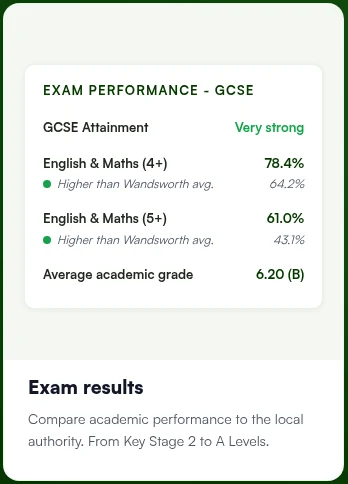
Exam results card showing a school's GCSE attainment rated 'Very strong', with English & Maths grade 4+ at 78.4% and grade 5+ at 61.0%, both above the local authority average, plus an average academic grade of 6.20.
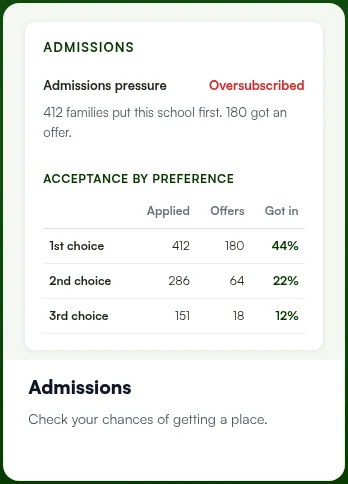
Admissions card showing a school marked 'Oversubscribed', with 412 families applying first choice and 180 offered places, and an acceptance-by-preference table for first, second and third choices.
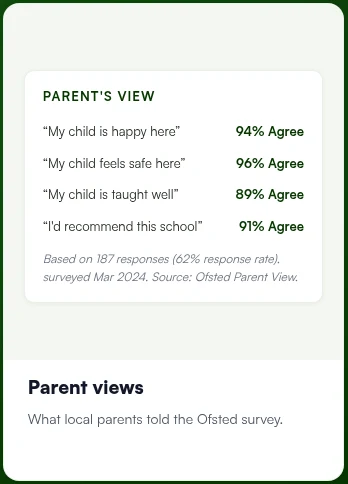
Parent reviews card from the Ofsted Parent View survey: 94% of parents agree their child is happy, 96% feel safe, 89% are taught well and 91% would recommend the school, based on 187 responses.

What you can check for each school

Every school in the results opens into a detailed profile. It is much more than a list of Ofsted ratings and distances. Here is the data you can compare for free:

Ofsted rating & full report
The latest overall Ofsted grade plus the four sub-judgements (quality of education, behaviour & attitudes, personal development, and leadership & management), with inspection dates and a link to the report.
GCSE results (secondary)
Attainment 8 scores, the percentage of pupils achieving grade 5+ in English and maths, and an average academic GCSE grade, each compared against the local authority average across recent years.
A-level & sixth form results
Average A-level grade and points, and the share of students gaining AAB or higher in facilitating subjects, so you can compare sixth forms before applying.
SATs / KS2 results (primary)
Key Stage 2 results for reading, writing and maths, including the percentage meeting the expected standard and working at a higher standard versus the local average.
Admissions & oversubscription
How many families applied versus how many places were offered, by first, second and third preference, so you can gauge how competitive and oversubscribed a school is.
Parent reviews (Ofsted Parent View)
What parents at the school actually think, from the official Ofsted Parent View survey: the share who say their child is happy and safe, is taught well, and would recommend the school, plus the response rate.
Class sizes & pupils
Pupil-to-teacher ratio against the local authority average, the number of pupils on roll, the gender split, and how full the school is against its capacity.
School type & provision
Whether each school is primary, secondary or all-through, its age range, plus faith/religious character, selective (grammar) admissions, nursery classes, sixth form and boarding.
SEN & disadvantage
Special educational needs provision and the types of need supported, plus the percentage of pupils eligible for free school meals compared with the local average.

State schools usually have the most data, because the Department for Education and Ofsted publish detailed results, admissions and pupil figures for them every year. Independent (private) schools are not part of that reporting, so for them you will often see less information, mainly the Ofsted-style rating and location.
Schools and house prices: the numbers

Being near a strong school is one of the most reliable price premiums in UK property. Here is what the research suggests:

8.0%
higher house prices near the top 10% of primary schools (DfE, 2017)
6.8%
higher house prices near the top 10% of secondary schools (DfE, 2017)
~0.5%
house price rise for each one-grade improvement in a school's Ofsted rating (DfE, 2017)
2 miles
search radius used to find the schools nearest a postcode

Figures are from the Department for Education study "House prices and schools" (2017), which analysed three years of England house price data. Premiums vary by area, school and year, so always check local sold prices for a specific postcode.

Schools near me vs. catchment areas

A 'schools near me' search shows the schools physically closest to a postcode. A catchment area is different: it is the area a school prioritises for admissions, it is set by each school or local authority, and it can change every year depending on how many siblings and nearby families apply. Because catchment boundaries move and are not guaranteed, we show the nearest schools by distance and always recommend confirming admissions criteria directly with the school.

Why buyers check schools before viewing

School quality shapes both day-to-day family life and resale value. Homes near high-performing and 'Outstanding'-rated schools consistently sell at a premium and tend to hold their value better in slower markets. Checking the schools near a postcode before you book a viewing helps you compare areas quickly and avoid falling for a home that doesn't fit your school plans.

Got Questions?

Enter a UK postcode into the search box above. You will see the nearest primary, secondary and independent schools plotted on a map, each with its Ofsted rating, school type and straight-line distance from the postcode. No sign up is required.

No. This is a 'schools near me' tool that shows the closest schools to a postcode by distance. It is not a catchment area checker. Catchment areas are not fixed boundaries; they are set by each school or local authority, can change every year, and often depend on how many siblings and nearby applicants apply. Always confirm admissions criteria directly with the school or local authority.

Yes. Proximity to a high-performing school is one of the most consistent price premiums in UK property. A Department for Education study (2017) found house prices were about 8.0% higher near the top 10% of primary schools and 6.8% higher near the top 10% of secondary schools, with prices rising by around 0.5% for each one-grade improvement in a school's Ofsted rating. Premiums vary a lot by region, so check local sold prices to see how this plays out in a specific area. house value calculator by postcode

Both state and independent schools near the postcode are shown together in one list, grouped by phase, with primary schools first, then secondary. Each entry shows the school's phase (primary, secondary or all-through), its latest Ofsted rating where available, and its straight-line distance from the postcode, so you can quickly see what is nearby.

Yes. Open any school to see its exam performance: for secondary schools we show GCSE Attainment 8 and the percentage of pupils achieving grade 5+ in English and maths, and for sixth forms we show average A-level grades and points. Each figure is shown next to the local authority average across recent years so you can see how the school compares with others nearby.

Yes. For primary schools the profile shows Key Stage 2 SATs results in reading, writing and maths, including the percentage of pupils meeting the expected standard and working at a higher standard, compared with the local authority average.

Each state school profile shows how many families applied versus how many places were offered, broken down by first, second and third preference for the latest year, with first-preference figures for earlier years for context. This lets you gauge how competitive and oversubscribed a school is before you apply or buy nearby. Admissions criteria still vary, so confirm details directly with the school or local authority.

Beyond Ofsted ratings and distance, each profile can show the pupil-to-teacher ratio versus the local average, number of pupils on roll, how full the school is against capacity, the four Ofsted sub-judgements, faith or religious character, whether the school is selective (a grammar school), nursery, sixth form and boarding provision, special educational needs (SEN) support, and the percentage of pupils eligible for free school meals.

Ofsted inspects schools in England and grades them on a four-point scale: Outstanding, Good, Requires Improvement and Inadequate. A higher grade reflects a stronger inspection outcome, but ratings can be several years old and do not capture everything that matters to a family, so treat them as one input among several.

Yes. The results show both state-funded schools and independent (private, fee-paying) schools near the postcode, listed separately so you can compare the options available in the area. State schools usually have the most detail, because the government and Ofsted publish their results, admissions and pupil figures every year. Independent schools are not part of that reporting, so for them you will often see less data, mainly the rating and location.

Distances are calculated as a straight line ('as the crow flies') between the postcode and each school, so the actual walking or driving distance will usually be longer. To check the real route, click the footsteps icon next to a school to open Google Maps with walking directions from the postcode. Use the map to judge which schools are realistically within reach.

School details and locations come from publicly available UK government education data, and inspection grades come from Ofsted. We refresh this data periodically. For full source details, see our data sources page. data sources